Future of driving
The Car Is the Last Ambient Space
Why the most useful place for an always-on assistant is not your home, your wrist, or your pocket.
Ambient computing was supposed to have arrived
The promise was specific and appealing: computing that recedes into the background, does not demand a screen or a login or a deliberate act of attention, and helps because it understands the situation rather than waiting for a person to describe it.
More than a decade of product attempts later, that promise is mostly unfulfilled. Speech recognition, on-device inference, and multimodal models are dramatically better than they were in 2014. The harder problem is that the physical settings we chose were wrong. The failures point directly at the one setting that works.
The home was too big and too contested
Smart speakers sold in enormous volume and then flattened into timers, music, weather, and lights. That is less a failure of demand than a failure of situational legibility. A house is not one space: it is a dozen spaces with different acoustics, occupants, and norms. A device on the kitchen counter can hear a voice, but it cannot reliably understand whether the speaker is the homeowner, a child, or a contractor, or whether dinner is being made or a room is full of guests.
The home is also the most privacy-contested space in a person’s life. Always-on sensing in a living room is a fight. Each extra sensor costs trust, so devices stay deliberately limited—and staying limited guarantees that they remain marginal.
Wearables had attention but no surplus
Watches, rings, and pendants solve proximity: they are always close. But when someone is wearing a device, they are usually doing something else that requires them. Ambient assistance needs an attention surplus—a stretch of time where hands and eyes are occupied but the mind is comparatively free. Most of a wearable’s day happens in contexts where the correct behavior is to say nothing.
Recent screenless AI wearables ran into exactly this. The interaction still had to be initiated. Once a person is initiating, the experience is back to being a phone with worse ergonomics.
The phone is structurally the opposite of ambient
A phone is an attention-capture device. Its commercial logic—notifications, feeds, badges, and the lock screen—is built to pull attention toward it. Ambient computing is defined by the absence of that pull. A calm layer cannot thrive on a substrate designed for interruption.
There are hard mechanical limits too. Mobile operating systems appropriately restrict continuous microphone and camera access in the background, and while driving a phone is often face-down in a cupholder, in a bag, or mounted somewhere the driver should not be looking at.
Four conditions for an ambient assistant
Taken together, these failures create a clear specification. An ambient assistant needs all four conditions at once:
The home fails bounded geometry and social legitimacy. Wearables fail geometry, attention surplus, and clean session boundaries. Phones fail attention surplus, social legitimacy, and session boundaries. The car passes all four.
- Bounded and predictable geometry: the device knows where it is, where people are, what the acoustics are like, and what is in frame.
- An attention surplus: sustained time where hands and eyes are committed to something else while the mind is available.
- Social legitimacy for continuous sensing: people already accept that a camera and microphone belong in this setting.
- Clean session boundaries: a defined beginning and end so the system knows when context starts and when it should stop.
The car passes
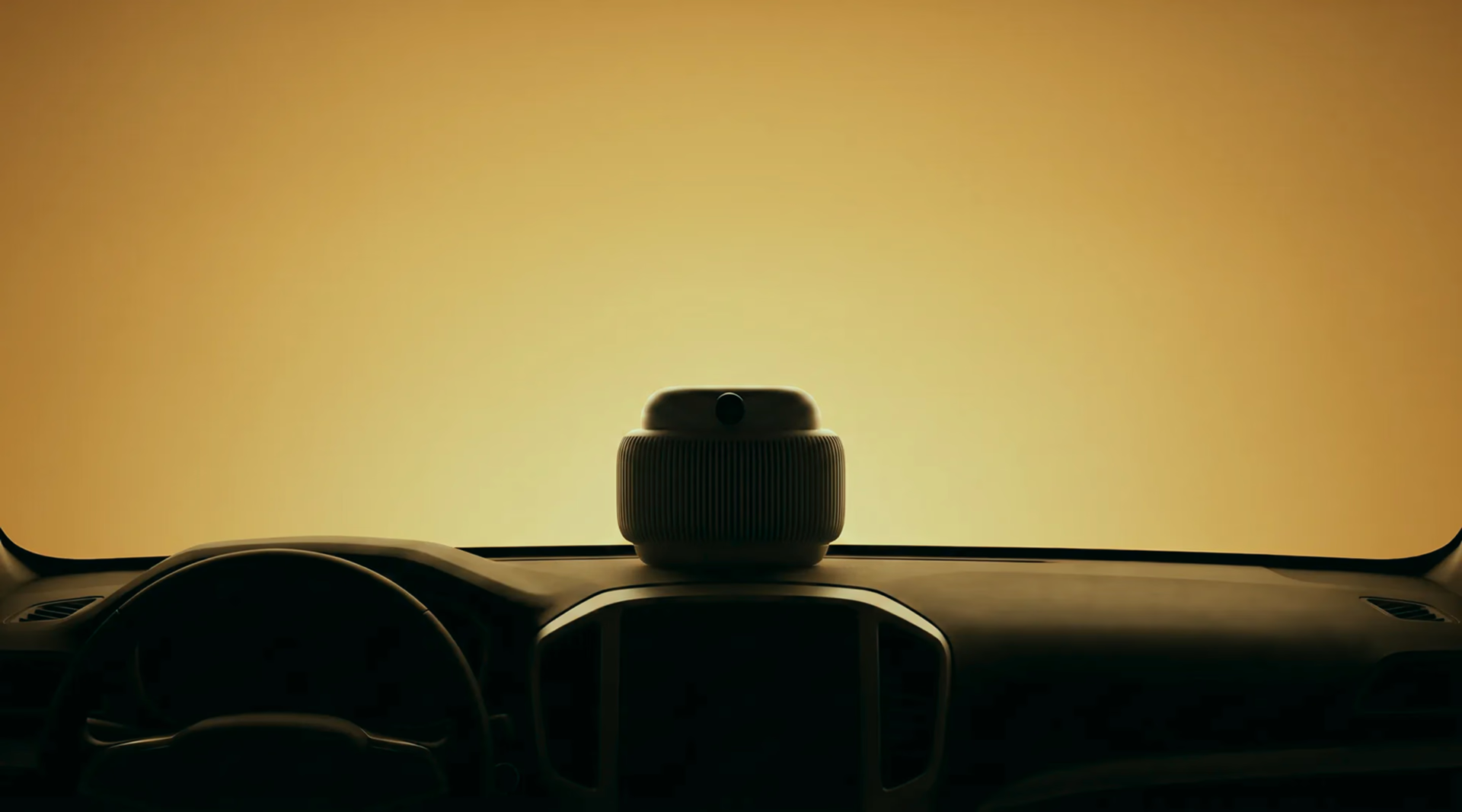
Geometry is fixed. The occupant is seated in a cabin with a stable acoustic profile, a known field of view, and at most a handful of people. A windshield-mounted sensor sees roughly the same world on day 400 as it did on day 1. A system that is not spending capacity re-solving the room can spend it on understanding.
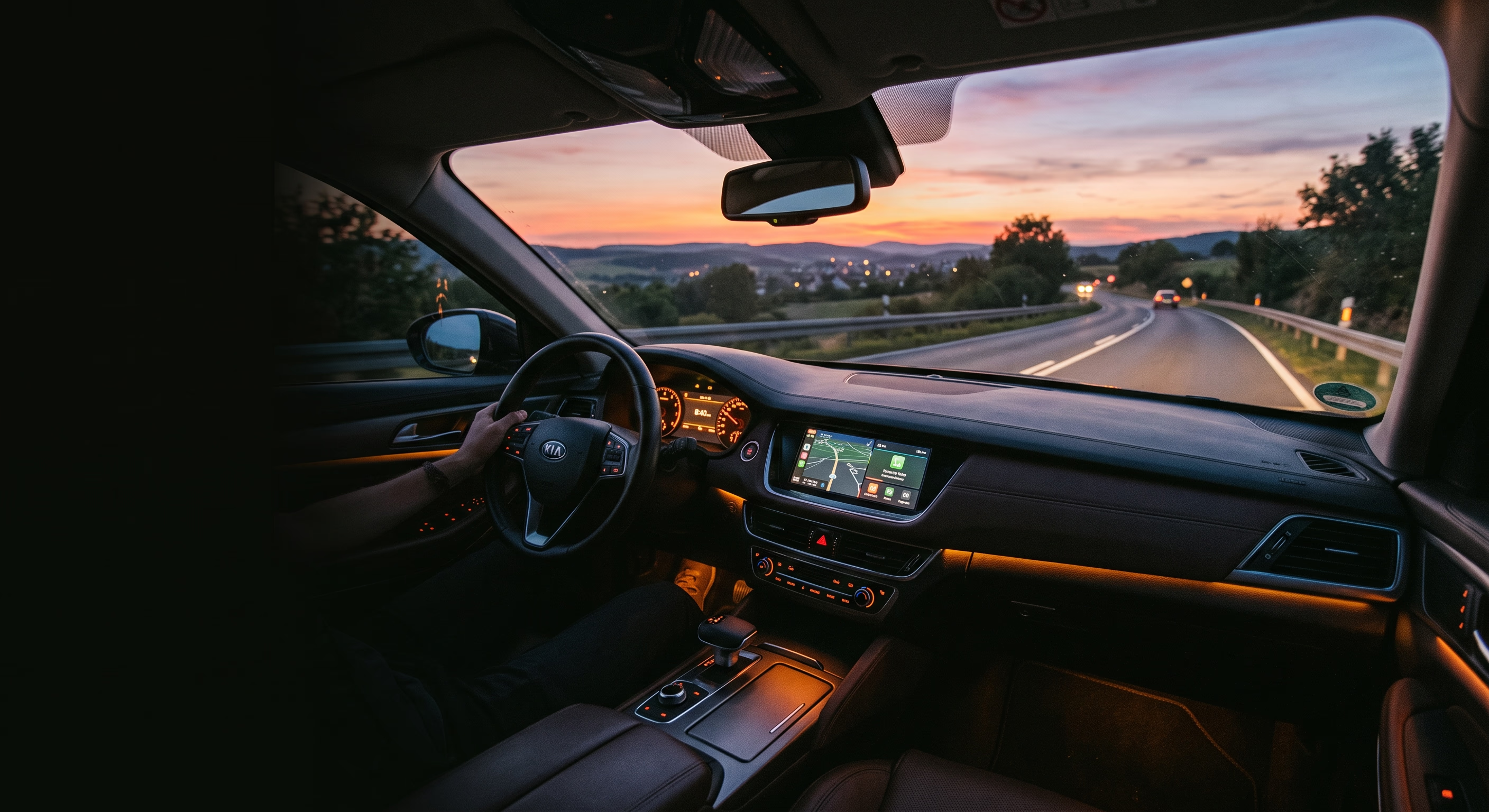
Driving also creates the defining attention surplus: hands on the wheel, eyes on the road, and a mind that is substantially free. It is why radio and podcasting became such natural in-car media. The time recurs daily, is bounded, and is far less fragmented than time at home.
Social legitimacy is already established. Cameras in cars are normal, dash cams are a mature consumer category, and hands-free voice calling has been standard for years. Road sensing arrives pre-justified because the road is public and the camera’s primary purpose is to protect the driver. Finally, session boundaries are given by the ignition: you get in, the session starts; you arrive, it ends.
The car is a transition layer
The stronger claim is not simply that the car is viable; it is uniquely valuable. The car is where people change roles: leaving home for work, leaving a difficult meeting before picking up a child, or moving between the separate contexts of a life. It is the physical and psychological corridor between those contexts.
Work software knows about work. A health app knows about health. A calendar knows appointments but not states of mind. The car observes the seam: the minutes spent leaving one thing and preparing for the next. The opportunity is not merely an assistant in a car, but a layer that understands those transitions because it lives within them.
Autonomy makes this bigger, not smaller
If cars drive themselves, the in-cabin category does not collapse. It expands. Today’s attention surplus exists despite the fact that driving consumes much of a driver’s capacity. Remove the driving task and the surplus becomes total: bounded, socially legitimate time with the occupant’s full attention available.
The question autonomy raises is not whether in-cabin experience matters. It is who owns it.
Boxes die, accounts survive
The average driver keeps a vehicle for years and owns many vehicles over a lifetime, often across different brands. Any experience that lives only inside a vehicle dies with that vehicle. An OEM assistant is structurally brand-locked and cannot follow a person to their next car if that car is from a competitor.
The right architecture is person-loyal and brand-neutral: hardware is replaceable, while the relationship is not. Preferences, patterns, history, and the accumulated understanding of how someone moves through a week should carry forward. The box is a sensor package with a lifespan. The account is the product.
Build the next drive
Make the road easier to enjoy and remember.
Join the Waybox waitlistKeep reading